

Trading
Explora una amplia gama de mercados con precios competitivos, liquidez profunda y herramientas de trading avanzadas.
Más información 
Plataforma
Opera sin interrupciones con la potente plataforma de TMGM, diseñada para ofrecer velocidad, precisión y una experiencia de trading superior.
Más información Plataforma de trading
Herramientas de trading
Academia
Aprende los fundamentos del trading con recursos ideales para principiantes, incluidas guías, seminarios web y análisis del mercado.
Más información Academia TMGM
Noticias y análisis
Obtén actualizaciones del mercado en tiempo real y análisis de expertos para adelantarte a las oportunidades de trading
Más información Noticias y análisis
Acerca de
Descubre qué distingue a TMGM: nuestra presencia global, solidez regulatoria y compromiso con la innovación en el trading.
Más información Por qué elegir TMGM
The Kiwi defies hot US inflation as Fed pause bets weaken the USD
- NZD/USD gains 0.55% to 0.5652 as the Greenback retreats.
- October Fed hike odds remain at 16% despite elevated inflation.
- NZ CPI could reshape RBNZ tightening expectations ahead of October's meeting.
The New Zealand Dollar ended the week on a higher note against the US Dollar, up 0.55% to 0.5652, as the Greenback weakened amid investors' skepticism about a Fed hike in October despite the US docket featuring red-hot inflation.
NZD/USD closes higher as October Fed hike skepticism shifts attention toward NZ inflation

US data revealed on Friday was mostly ignored by market participants. Even though the Fed revealed that Industrial Production in September grew 0.7% MoM above estimates and August’s 0.1% expansion, the focus was on inflation.
The release of US consumer inflation data, which exceeded estimates of 3.6% at 3.7% YoY, and on the producer front at 6.3% YoY, up a full percentage point from forecasts of 5.3%, did not raise the odds of a Fed October rate increase, as might have been expected.
The probability of a Fed rate hike is 16%, according to Prime Terminal data. Still, this favors further downside in NZD/USD, as US interest rates are 125 basis points higher than in New Zealand.
Several Fed officials, although penciling in two hikes for 2026, with the first having happened a month ago, said patience is needed, implying that a hike in Decembers is most likely than this month. Others, like Cleveland Fed Beth Hammack, have expressed concern that inflation has remained stubbornly high for five and a half years, above the 2% goal.
At the same time, Fed Chair Kevin Warsh disappointed investors by failing to provide guidance on future interest rates during a speech at the IMF forum on Friday, even though he acknowledged the strength of the US economy.
In New Zealand, the economic docket remained light but for the next week, the Trade Balance is expected on October 18, followed by the Consumer Price Index (CPI) for Q3 on a quarterly and yearly basis.
If next week's New Zealand CPI comes hotter than expected, this could prompt investors to fully price in an RBNZ rate hike at the October 28 meeting, with odds at 85% for a hold and 40 basis points of further tightening towards the end of the year.
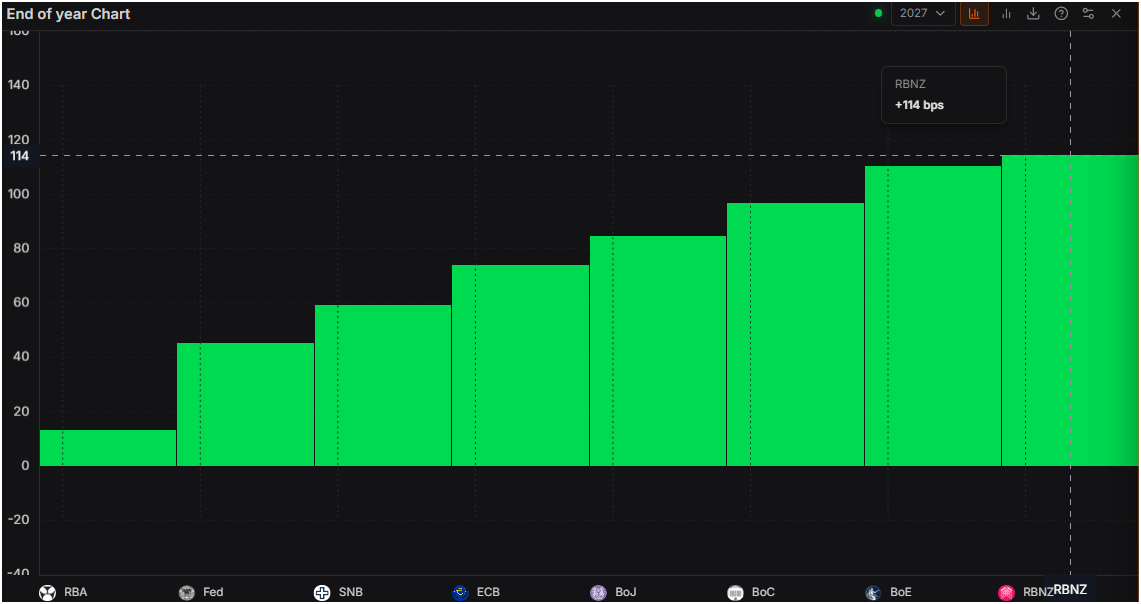
Of note, for 2027, money markets had priced in 114 basis points of tightening towards the end of the year, reflecting the more hawkish central bank amongst the major currencies.
NZD/USD Price Forecast: Technical outlook
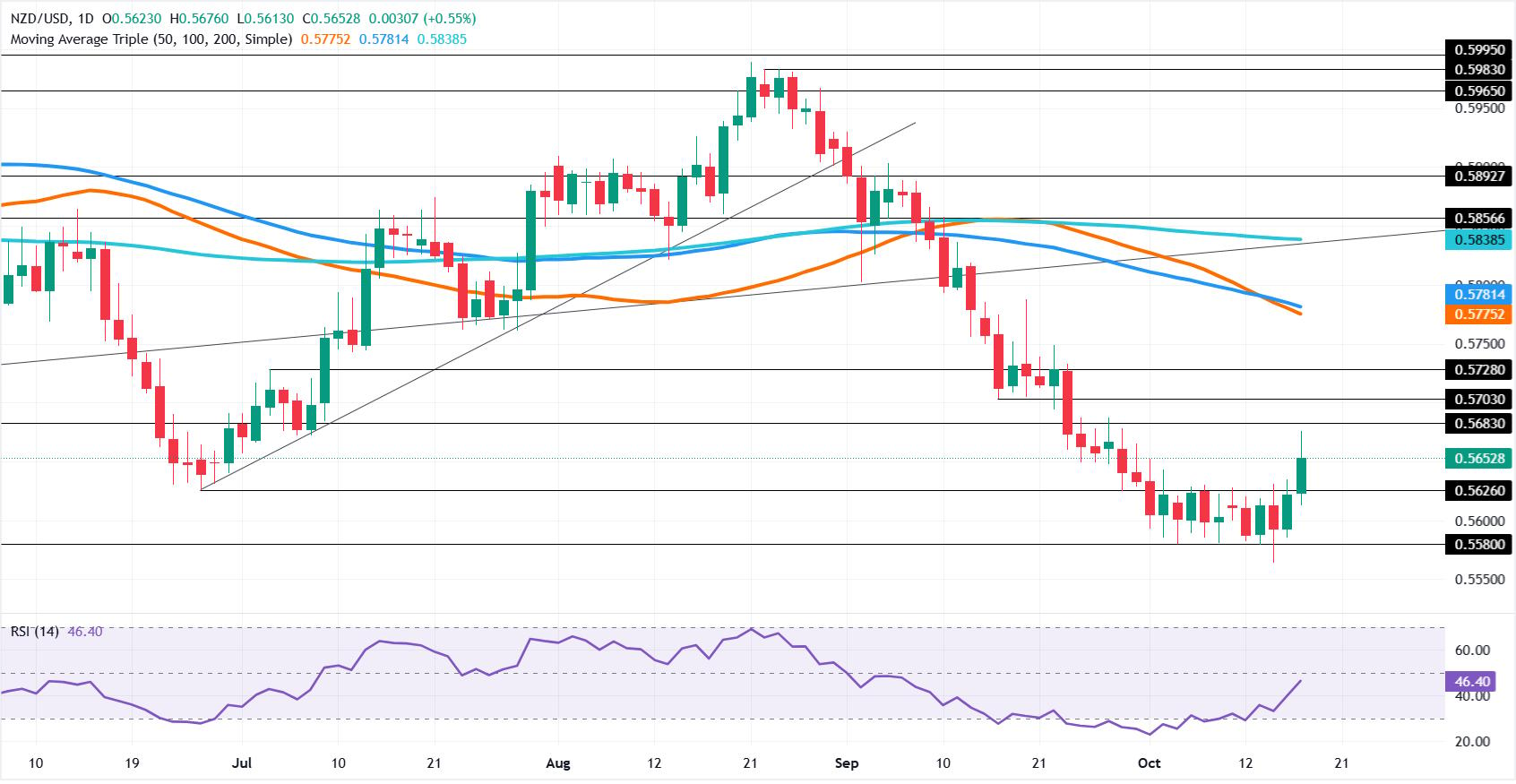
The NZD/USD price action shows that the pair bottomed around 0.5580-0.5600, triggering a rally to an 11-day high of 0.5674 before settling at current levels.
Even though all the daily Simple Moving Averages (SMAs) indicate a bearish bias, the Relative Strength Index (RSI) suggests that momentum is shifting bullishly, an indication that, although the downtrend is in place, we could be witnessing an early stage of a reversal.
If NZD/USD reclaims 0.5750, this could pave the way for a move toward the confluence of the 50- and 100-day SMAs, each at 0.5775-0.5781. This could open the door to challenge the 200-day SMA above the 0.5800 milestone at 0.5838.
For a bearish continuation, the NZD/USD must drop below the October 14 swing ow of 0.5564, towards the 0.5500 mark.
New Zealand Dollar FAQs
The New Zealand Dollar (NZD), also known as the Kiwi, is a well-known traded currency among investors. Its value is broadly determined by the health of the New Zealand economy and the country’s central bank policy. Still, there are some unique particularities that also can make NZD move. The performance of the Chinese economy tends to move the Kiwi because China is New Zealand’s biggest trading partner. Bad news for the Chinese economy likely means less New Zealand exports to the country, hitting the economy and thus its currency. Another factor moving NZD is dairy prices as the dairy industry is New Zealand’s main export. High dairy prices boost export income, contributing positively to the economy and thus to the NZD.
The Reserve Bank of New Zealand (RBNZ) aims to achieve and maintain an inflation rate between 1% and 3% over the medium term, with a focus to keep it near the 2% mid-point. To this end, the bank sets an appropriate level of interest rates. When inflation is too high, the RBNZ will increase interest rates to cool the economy, but the move will also make bond yields higher, increasing investors’ appeal to invest in the country and thus boosting NZD. On the contrary, lower interest rates tend to weaken NZD. The so-called rate differential, or how rates in New Zealand are or are expected to be compared to the ones set by the US Federal Reserve, can also play a key role in moving the NZD/USD pair.
Macroeconomic data releases in New Zealand are key to assess the state of the economy and can impact the New Zealand Dollar’s (NZD) valuation. A strong economy, based on high economic growth, low unemployment and high confidence is good for NZD. High economic growth attracts foreign investment and may encourage the Reserve Bank of New Zealand to increase interest rates, if this economic strength comes together with elevated inflation. Conversely, if economic data is weak, NZD is likely to depreciate.
The New Zealand Dollar (NZD) tends to strengthen during risk-on periods, or when investors perceive that broader market risks are low and are optimistic about growth. This tends to lead to a more favorable outlook for commodities and so-called ‘commodity currencies’ such as the Kiwi. Conversely, NZD tends to weaken at times of market turbulence or economic uncertainty as investors tend to sell higher-risk assets and flee to the more-stable safe havens.
Artículos destacados
1The Kiwi defies hot US inflation as Fed pause bets weaken the USD2Ethereum slips below $2,400 as Oil surges, ETF outflows mount3Canada: Energy-driven resilience with limited core pass-through – RBC4Taiwan Dollar: Foreign outflows pressure currency – OCBC5Silver Price Forecast: Bears target $55 as RSI nears oversold6Gold stumbles as US yields eclipse fading October Fed hike bets7Circle says USDC settled $36T in H1 2026, revenue hits $1.4B8Bank of Korea: Policy patience case – Standard Chartered9EUR/USD Price Forecast: Recovery remains fragile below key moving averages
COTIZACIONES EN VIVO

TODO SOBRE FOREX
Margin Call Meaning: What It Is, What Triggers It and How to Avoid One
Top 15 Weakest Currencies in the World
Top 15 Strongest Currencies in the World
Is Forex Trading Halal?
Best Time to Trade Forex
Forex Trading vs Futures Trading
Forex Trading vs Stock Trading
Forex Trading vs Crypto Trading
Is Forex Trading Profitable In 2026?
¡Comience ahora!
Regístrese y acceda a los mercados globales en menos de 3 minutos

Conéctese con nosotros









Contactos
Teléfono: +61 2 8036 8388
Fax: +61 2 8036 8388
Correo electrónico: support@tmgm.com
Web: https://www.tmgm.com



La información proporcionada en este sitio web es únicamente de carácter general y no constituye asesoramiento financiero personal. Antes de actuar sobre cualquier información de este sitio web, debe considerar la idoneidad de la información en relación con sus objetivos, situación financiera y necesidades. Invertir en CFD y contratos de margen de FX conlleva riesgos significativos y no es adecuado para todos los inversores. Puede perder más que su depósito inicial. Usted no posee ni tiene ningún interés en el activo subyacente. Le recomendamos que busque asesoramiento independiente y se asegure de comprender plenamente los riesgos involucrados antes de operar. Es importante que lea y considere el documento de divulgación antes de adquirir cualquier producto listado en el sitio web. La información y los anuncios ofrecidos en este sitio web no están destinados al uso por parte de ninguna persona en ningún país o jurisdicción donde dicho uso sea contrario a las leyes y regulaciones locales. Los productos y servicios ofrecidos en este sitio web no están destinados a residentes de Estados Unidos, Malasia y Tailandia.
TMGM está autorizado y regulado en varias jurisdicciones.
Trademax Australia Limited, que opera como TMGM, está regulada por la Comisión Australiana de Valores e Inversiones (ASIC), AFSL n.º 436416, y está ubicada en Level 28, One International Tower, 100 Barangaroo Avenue, 2000 Sydney, NSW Australia.
Correo electrónico: support@tmgm.com.au
Trademax Global Limited, que opera como TMGM, está autorizada y regulada por la Comisión de Servicios Financieros de Vanuatu (VFSC), número de registro 40356, y está registrada en 1276, Kumul Highway, Port Vila, Vanuatu, República de Vanuatu.
Correo electrónico: support@tmgm.com
Trademax Global Markets (SE) Limited, que opera como TMGM, está autorizada y regulada por la Autoridad de Servicios Financieros (FSA) de Seychelles, con número de licencia SD224. La empresa está registrada en Office No 13, Providence Estate ABIS Centre, Mahe, Seychelles.
Correo electrónico: support@tmgm.com
Trademax Global Markets (International) Pty Ltd, que opera como TMGM, está autorizada y regulada por la Comisión de Servicios Financieros de Mauricio (FSC) con licencia n.º GB22201012, y está registrada en 33, Edith Cavell Street C/o IQ EQ Fund Services (Mauritius) Ltd Port Louis, 11324 Mauricio.
Correo electrónico: support@tmgm.com
Copyright © TMGM. Todos los derechos reservados